



Buscador global


Mostrando del 141 al 149 de 149 resultados para: La guerra de Nuestros Abuelos filtrando por: 3º y 4º de ESO

London
Students will travel to London to learn a lot of facts about The UK and its main cities and write an opinion article about teenagers and free time. Each section is going to take place in a different part of London. In each place, there is a proposal of tasks, challenges and activities. At the end of the project, they will have:
- read official websites of different tourist attractions and about entertainment in London.
- watched videos about the city.
- posted tweets.
- recorded a video.
- recorded a podcast.
- learnt the structure of an opinion article.
- revised the Present Simple, Adverbs of frequency and Questions words
- learnt vocabulary about entertainment, restaurants and things to do in London.
Gazteentzako aholkularitza-zentroa
HBI hau proposamen didaktikoa da, eta gizakiaren ugaltze-aparatua lantzen du, baina ez soilik zati anatomiko eta funtzionala, baita sexu-aniztasunarekin, genero-berdintasunarekin eta ohitura osasuntsuekin lotutako partea ere. Proiektu gisa aurkezten da, ikasleek hainbat ataza egiteko, ikasi, hausnartu eta eztabaidatzeko eta entrenatzeko, gero zenbait baliabide sortu aldera (liburuxkak, zerrendak, konparazio taulak, mapa kontzeptualak, etab.). Azkenik, hori guztia hartu eta erakusketa bat ipiniko dute ikastetxean. Erakusketa horretan ikasleak gaiari buruzko aholkulari jardungo dira.

Belfast
Students will travel to Ireland to learn a lot of facts of Belfast and design and record an interview. Each section is going to take place in a different and famous part of the city of Belfast. In each place, there is a proposal of tasks, challenges and activities. At the end of the project, they will have:- read official web pages.
- watched promotional.
- posted tweets.
- recorded a video.
- recorded a podcast.
- made a digital poster.
- learnt the difference between the past simple and past continuous.
- learnt the difference between -ed and -ing adjectives.
- learnt the pronunciation of /ed/
- Vocabulary: shops, clothes and shopping centres
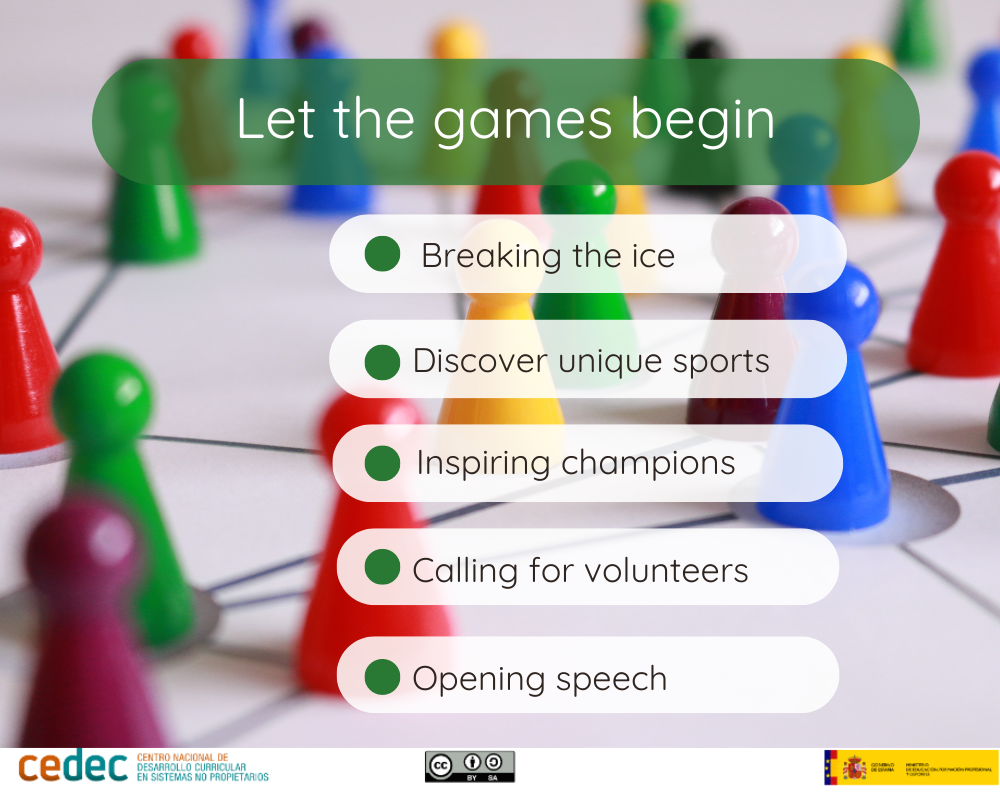
Let the games begin
Students are going to think of ways of making a positive impact on the world around them as well as mastering their English skills through engaging, interactive activities. Through service learning, students will develop the competences that define their output profile when they finish their compulsory secondary school years. At the end of the project, they will have:
- read web pages about sports.
- watched videos about the benefits of sports and inspiring world athletes.
- taken part in a group discussion.
- mediated a form.
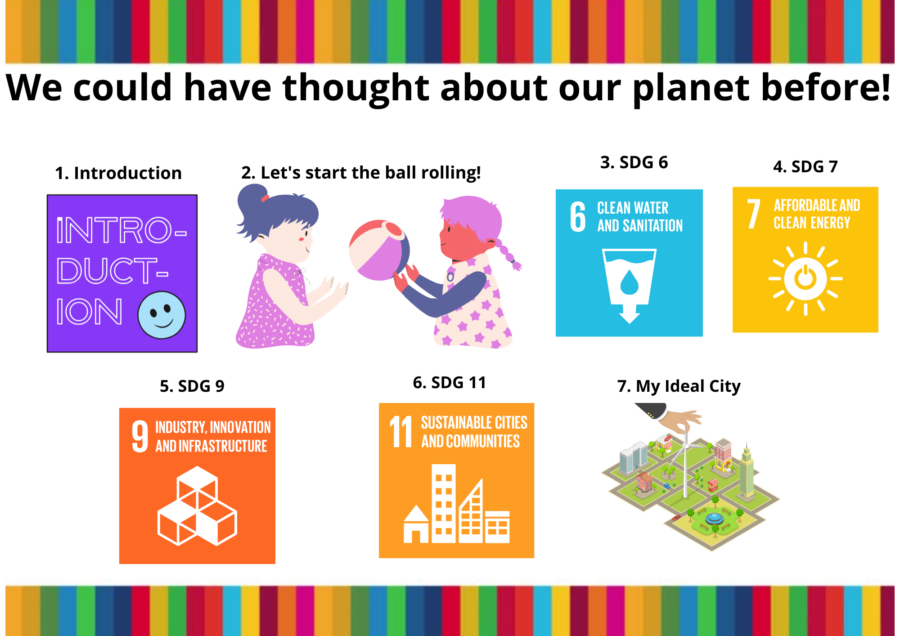
We could have thought about our planet before
This OER will improve both English skills and ICT ones by using as a context the Agenda 2030: SDG 6, 7, 9 & 11. Students will develop the key competences and the specific competences. At the end of this project, they will have learnt:
- The meaning of clean water, sanitation, affordable and clean energy, industry, innovation, infrastructure, sustainable cities and communities.
- How to explain information, remember details and read awareness.
- How to develop research skills and visual design skills.
- How to express: single past actions which have a connection with the present and unfinished actions which started in the past and continue to the present.
- How to make clear which action happened first.
- How to use relative pronouns and distinguish between defining and nondefining clauses
- How to review the pronunciation of the -ed ending in regular verbs.
- How to mediate
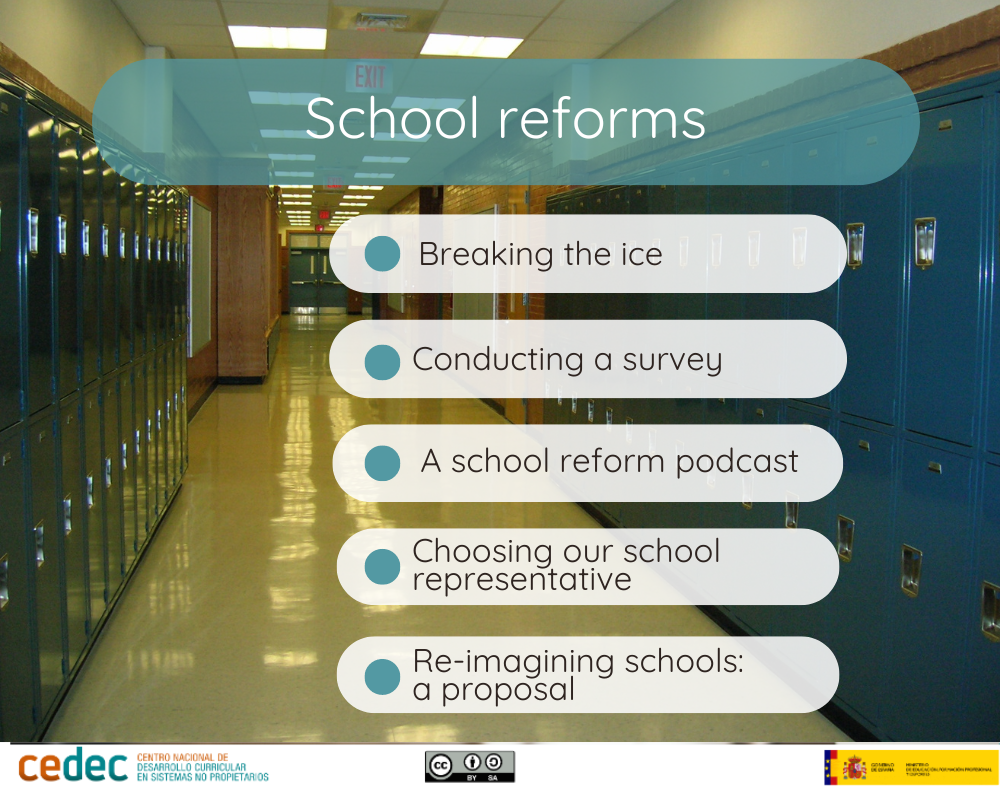
School reforms
Students are going to think of ways of making a positive impact on the world around them as well as mastering their English skills through engaging, interactive activities. Through service learning, students will develop the competences that define their output profile when they finish their compulsory secondary school years.
At the end of the project, they will have:
- read web pages about how to improve schools.
- listened to podcasts about educational issues.
- learnt vocabulary about education.
- learnt how to report information.
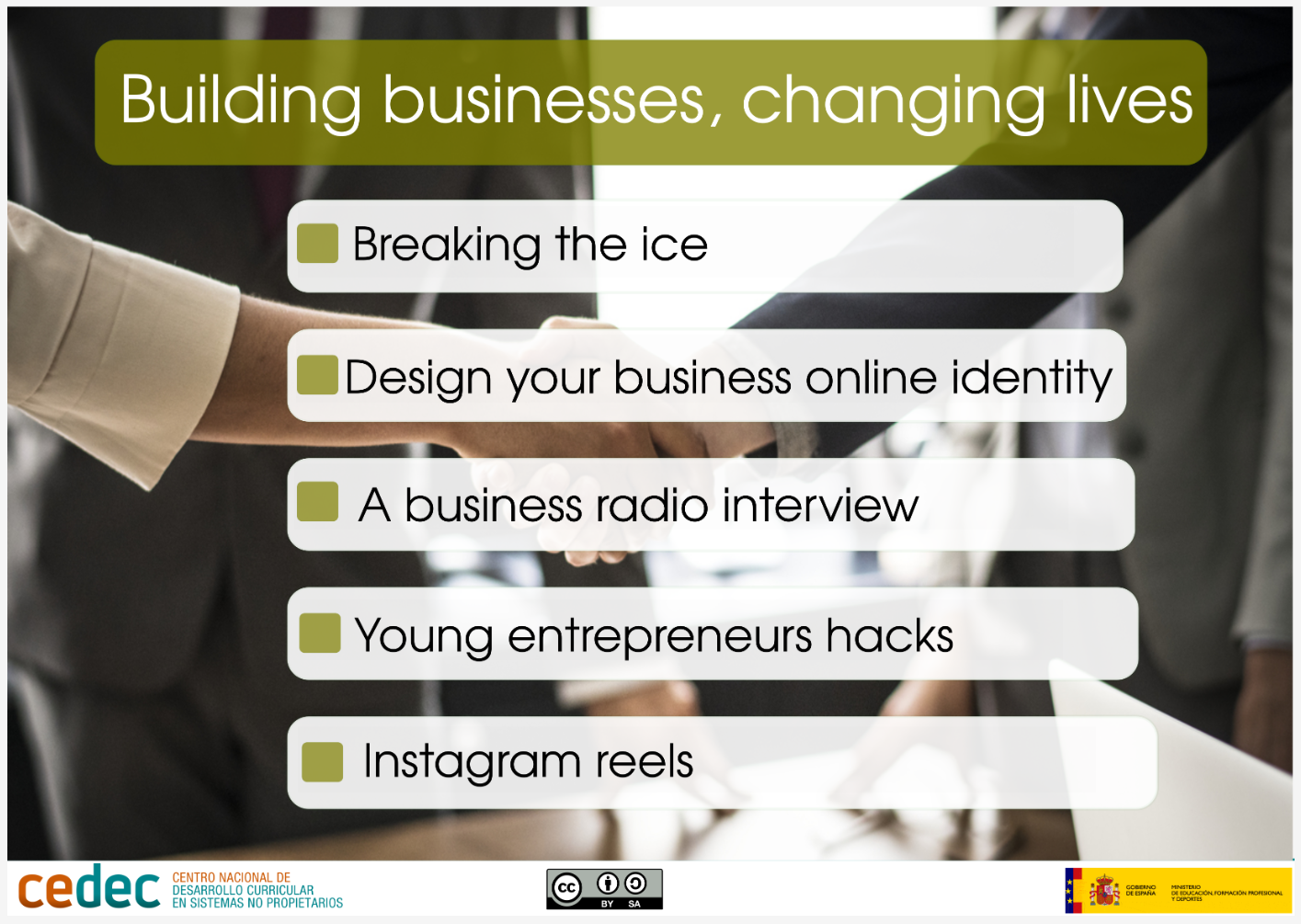
Building businesses, changing lives
Students are going to think of ways of making a positive impact on the world around them as well as mastering their English skills through engaging, interactive activities. Through service learning, students will develop the competences that define their output profile when they finish their compulsory secondary school years. At the end of the project, they will have:
- read web pages
- watched videos of entrepreneurs
- listened and recorded an interview
- given advice
- revised present and past tenses.
- used intonation in questions.
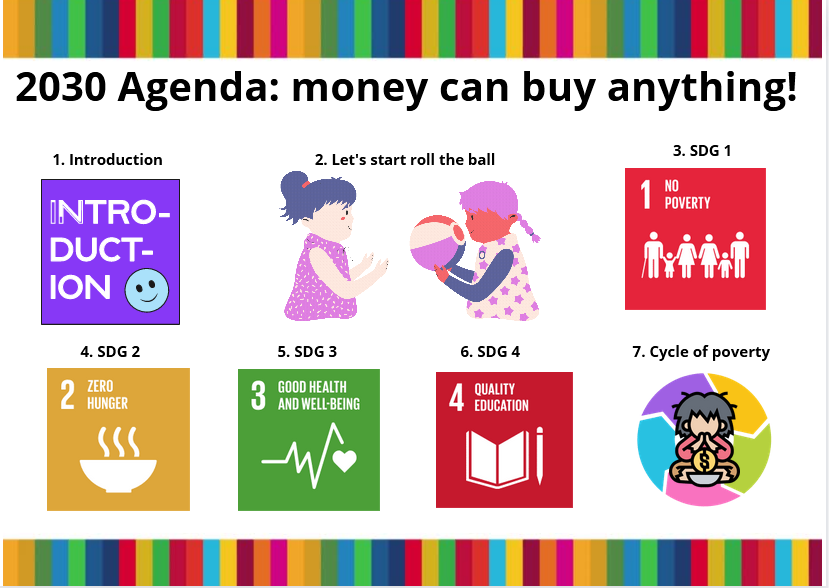
Money can buy anything!
This OER will improve both English skills and ICT ones by using as a context the 2030 Agenda: SDG 1, 2, 3 & 4. Students will develop both: key and specific competences. At the end of this project, they will have learnt:
- life necessities
- meaning of living in poverty, hunger, good health & well-being, education of quality and vocabulary related their semantic field.
- to explain information.
- to remember details.
- to skim and scan articles written in not adapted English.
- to identify countable & uncountable nouns and to use quantifiers with them.
- to develop research skills and visual design skills.
- to express ability, permission, prohibition, obligation and lack of obligation and to give advice.
- to use comparative and superlative adjetives.
- to use connectors of opinion, sequence, addition, etc.
- to pronounce sounds we do not have in our native language
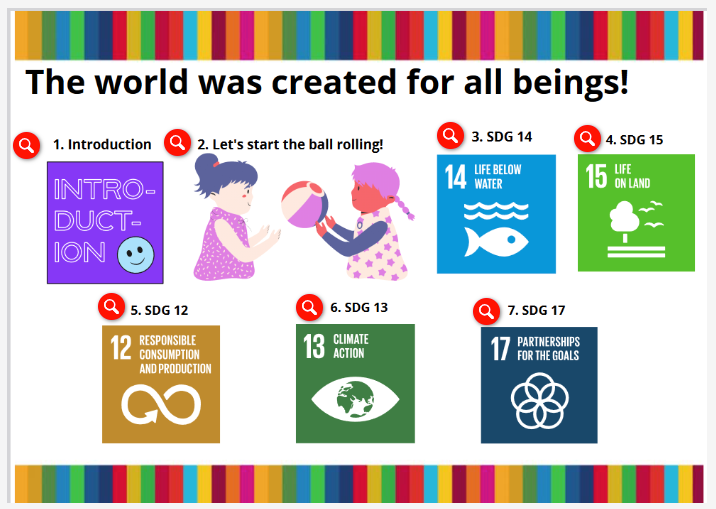
The world was created for all beings
This OER will improve both English skills and ICT ones by using as a context the Agenda 2030: SDG 12, 13, 14, 15 & 17. Students will develop the key competences and the specific competences. At the end of this project, they will have learnt:
- To respect life below water, life on land and the environment.
- To know the meaning of responsible consumption and production and partnership for goals.
- To explain information, remember details and reading awareness.
- To skim and scan articles written in not adapted English.
- To develop research skills and visual design skills.
- To show interest in the person or object that experiences an action rather than the person or object that performs the action (Passive Voice).
- To recognise false friends.
- To pronounce cognates words.
- Vocabulary related to life below water, life on land, responsible consumption and production, climate change and partnership.